

Every American can tell you a detailed history of Nazi Germany, usually ending at the part where we showed up and kicked their kraut asses and saved Europe from certain doom. Every American can also tell you a fairly accurate account of the Soviet Union, and how communism collapsed and freedom won the day. I pick these two examples for a few reasons. First, it was the Soviet Union who snuffed out the Nazi flame, not the United States, but the Soviets became our next arch-nemesis so we tend not to give them the credit. Second, while the Soviet Union did collapse, it was under its own dictatorial weight, not necessarily because freedom came out on top. Thirdly, these are the only dictatorships most Americans know anything about. That’s because Nazi Germany and the Soviet Union are our vanquished foes. Not so much communist China, because they have become our business partners. Not so much the military juntas in South America, because we were actively involved in those regimes. History is written by the winners, after all, and part of being a writer is cutting the bad parts out of the story.
Maybe we forget about the South American dictatorships because they weren’t very scary. Those countries spent the 20th century not doing very well for themselves. A poor dictatorship doesn’t threaten world stability as much as one with thousands of nuclear warheads. That doesn’t mean we should forget about them, we can still learn from the way these tyrannies rose and fell.
Today’s story begins just south of Rio de la Plata, east of the Andes mountains. Before World War II, before the Cold War and related “police actions” around the globe, Argentina was one of the wealthiest countries on planet Earth. Then they fell from grace with record speed. They went from an industrial superpower to almost nothing in less than fifty years. All their wealth was erased under a weird new brand of socialism that blurs the line between far-left and far-right. They kept coming back to democracy, only to have rigged elections be overturned by one coup d’etat after another. This culminated in a military dictatorship during the 1970s which was so tyrannical, and so original in their evils, that they should be in the same halls of infamy as the Axis powers themselves. To this day, the country is an economic disaster riddled with corruption, poverty and crime.
So let’s dive into this fascinating story. For context, we go back to the very beginning of the 20th century in order to see why Argentina was doing so well in the first place.
Get Spud Content Delivered Right Up Your Butt
Join the email list for updates, new blogs, special deals, and more
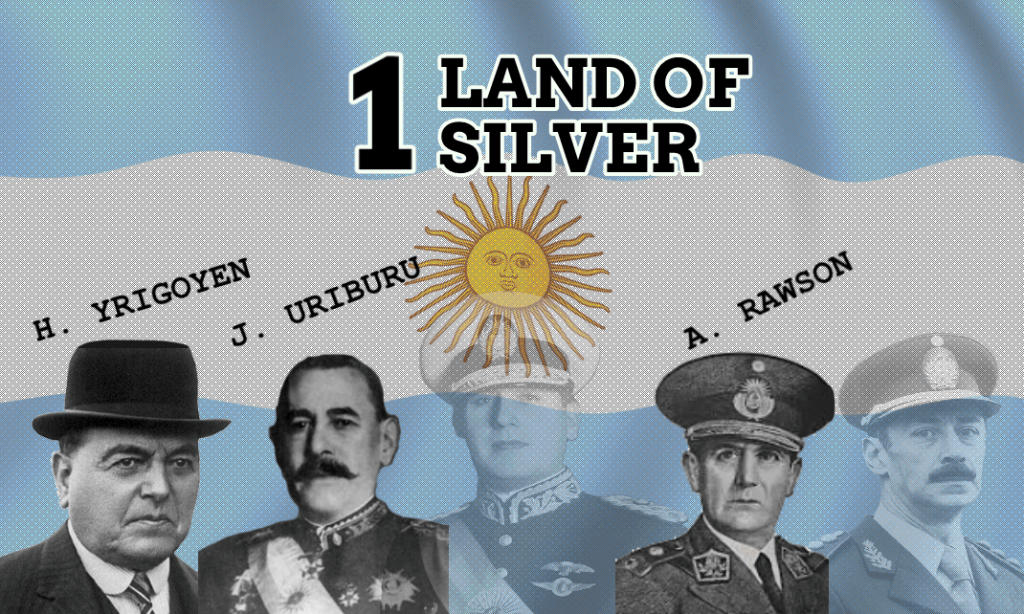
Based on how Argentina looks right this minute, you wouldn’t think that it was a treasure trove of natural resources. The very name of the country comes from the Latin argent, meaning silver, from the valuable ores found in the Andes Mountains. The country also boasts arable farmland, loads of grazing land for livestock, and prime ocean location for international trade.
Argentina gained independence from Spain in 1818. By the turn of the 20th century, partially thanks to major immigration from Spain and Italy, this piece of real estate was turning a fortune for the sovereign Argentines. Argentina managed to stay out of World War One, opting instead to stay home and work out a huge manufacturing and farming industry. After the Great War, they made a killing by shipping their stuff to Europe, who’s industry and infrastructure had been blown to bits. By the 1920s, Argentina was on par with the mighty United States as far as economic power goes. In fact, Argentina managed to economically outpace their former colonizer state until 1962.
The Roaring Twenties ended with a famous stock market crash and the resulting Great Depression rocked the globe. Argentina was not immune, and their economy took a sharp downtown. Many saw this as a result of government corruption, like a certain military officer named General José Uriburu. He noticed that while the free world was suffering under the Depression, Fascist Italy and Nazi Germany were thriving. Clearly, they were doing something right. In 1930, General Uriburu led a coup d’etat against the sitting president Hipólito Yrigoyen with the aim of setting up a fascist government of his own. This was a hard sell, considering that free enterprise was what had made Argentina so powerful for so long. Uriburu’s fellow rebels weren’t on board. He relinquished control after a couple of years and Argentina returned to democracy, but it wasn’t the same democracy they had just overthrown. The ruling party used election fraud and intimidation tactics to make sure they remained in power. That’s the system the country ran with for the next decade.
Fascism, of course, ruined its brand by going to war with the rest of Europe in 1939, and by this time Argentina had yet to recover financially from the coup d’etat. This corrupt democracy wasn’t doing the trick. The Argentines could see the war in Europe, and the Soviet Union was finally starting to come into its own. The seed of socialism, as a reaction to economic trouble and shady elections, was planted in Argentina. Another coup d’etat unseated president Ramón Castillo in 1943 with tremendous support from the working class. General Arturo Rawson (also a member of the 1930 coup), became President that same year. His regime was explicitly anti-communist, even though he represented the Labor Party, which anyone who’s paid attention to 20th century history should immediately recognize as a bad move.
Argentina’s new military junta didn’t share its predecessor’s love for fascism, so in March of 1945, Argentina declared war on the Axis Powers. The Axis Powers fell a month later, and World War II came to a close. Meanwhile, the new military dictatorship in Buenos Aires was having a hard time keeping their own regime together. Over the next three years, each new President came to power by forcing the last guy out at gunpoint. While the military leaders bickered, an unknown colonel was making a lot of friends among labor unions, Labourist Party bigwigs, and even outspoken communists, despite the latter group being actively prosecuted by the regime.
VIPERHAWK: WITNESS PROTECTION
A hilarious sci-fi adventure! Miguel Murillo is a smuggler for the Irish mob, and if these witnesses don’t get to a distant planet on time then there will be war…
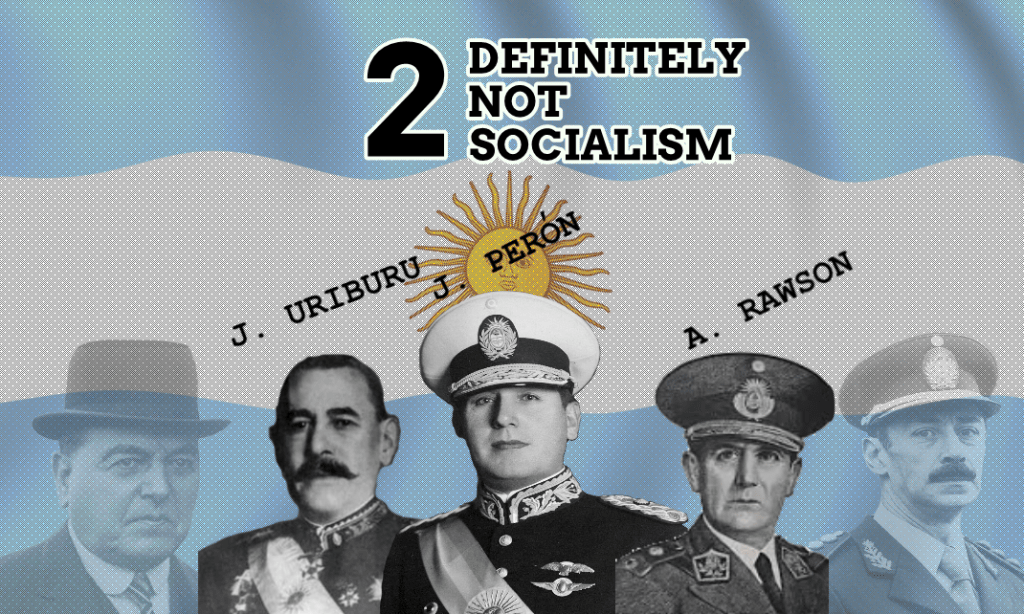
Before beginning the coup of 1930, General José Uriburu was on the hunt for recruits. The War Academy brought to the team an unknown but talented officer named Juan Domingo Perón. Perón didn’t like Uriburu’s vision of a military dictatorship and sided with another general on the planning team, Augustín Justo (who would serve as President of Argentina right after Uriburu). After the coup was successful, Uriburu banished Perón to a remote post near the Andes mountains. Perón continued to prove himself as an officer, eventually joining the faculty of the War Academy and becoming a prolific writer and teacher in the subject of military history.
Perón served as an attaché in Argentine embassies around the world, notably in Berlin and Rome, where he was able to study the governments of Hitler and Mussolini up close. Both countries were performing very well in the 1930s in terms of economic power, military might, and industrial output. Perón became an advocate for democratic socialism during this time, perhaps having a change of mind about the coup d’etat he had missed out on in 1930. His home country was falling behind and the post-Uriburu democracy was steeped in corruption and fraud. Perón returned to Argentina in 1941, believing that what he learned in fascist Europe was the key to correcting his homeland’s course.
President Ramón Castillo’s victory was one of the most fraudulent elections in Argentine history. It was lousy with nepotism, bribes and political favors to wealthy friends. This is exactly the sort of thing Juan Perón was fed up with and believed his democratic socialism could fix, so he teamed up with General Rawson for the coup of 1943.
Another successful coup on the books, and Perón was appointed as the head of the Ministry of Labor. It was a minor position, but he took full advantage of the chance to push social reforms that he believed would help the working class. He improved working conditions (though not wages) considerably. Between rent freezes, social security programs, yearly bonuses for all workers, and a very successful fundraising effort after the 1944 San Juan Earthquake, Perón was becoming very popular with a poor and frustrated Argentina.
The Argentine military at the time consisted of only the Army, made up of working class and common folk; and the Navy, which was more aristocratic. The generals leading the new junta were all Navy stock, and Perón was an Army guy. The Argentine working class and the Army saw Perón as a populist and a man of the people. The conservative, Catholic, and increasingly anti-communist Navy dictatorship saw him as a radical and a threat. To make matters worse for Perón, the junta declared war on his Axis heroes in 1945.
World War II ended a month later. That September, the junta got sick of Perón and his increasingly socialist rhetoric. Perón was forced to resign, then arrested, which triggered riots across Buenos Aires. The workers, the unions, and the socialists, now calling themselves Peronists, demanded his release, and the government relented. The military dictatorship fell shortly thereafter and Argentina returned to democracy. Juan Domingo Perón, running on the Labour Party ticket, won a landslide victory and was sworn in as President of Argentina in June, 1946.
It should come as no surprise that a man heavily influenced by Nazi Germany would become a dictator in his own right. Very early on in his reign, Perón nationalized all the major industries, used force and coercion to maintain power, silenced political dissidents, and famously granted refuge to Nazi war criminals- even giving a few of them government positions.
Perón’s social policies brought unemployment to near zero, but his isolationist policies meant that there was no money coming into the country. Perón’s government wasn’t helping rebuild Europe the way Argentina did twenty years earlier. They were sorely missing out on the income from that trade. Instead, Perón borrowed and printed all the money he could to pay for his social reforms. If you didn’t like the inflation that caused, you might find yourself behind bars. Argentina became a textbook standard socialist country- just as tensions between the capitalist West and the communist East were turning into a Cold War.
Perón managed to keep Argentina off of both faction’s radar with some rebranding. The Labour Party, a hallmark of socialism, became the Judicialist Party. Perón’s brand of nat-soc militarism became Justicialism, or Peronism. Peronism was full of all the same talking points as any other socialist society (and wasn’t fooling the United States) but the West had bigger fish to fry. The Soviet Union had nuclear weapons, Argentina did not.
Of course, he wouldn’t stay in power forever. In 1955, the military once again had had enough of the current leadership. The Navy bombed their own capital in an attempt to kill Perón. He lived, but was ousted a few months later. For those of you keeping score, that’s three coups d’etat in twenty five years. Perón was exiled to Spain, but his story isn’t over yet. In fact, the violence is just getting started.
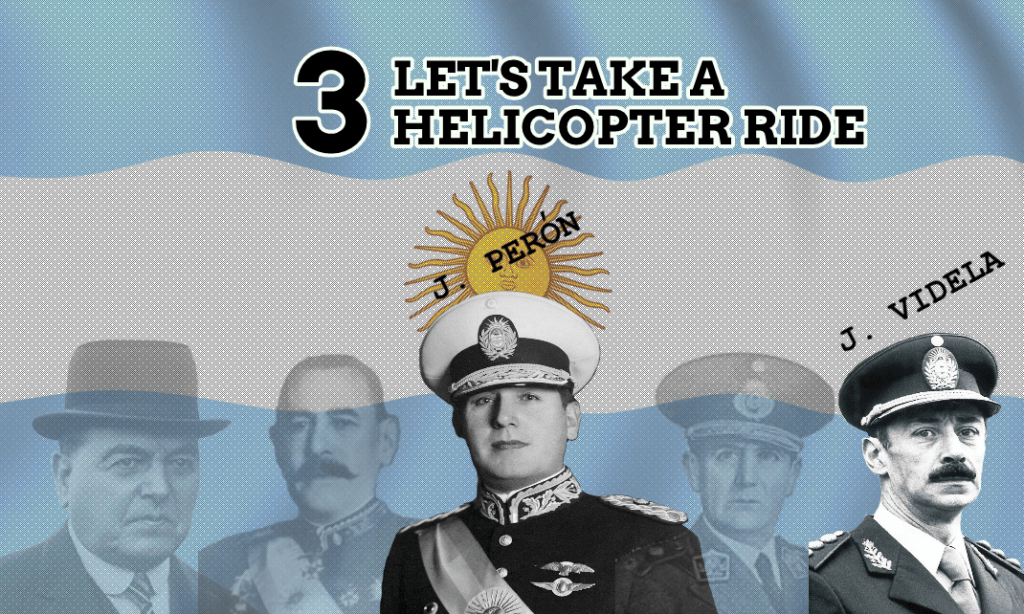
The 1955 coup which deposed Perón was mainly headed by the Judicialist Party’s main rival, the Unión Cívica Radical, or UCR. The UCR military rule followed in the footsteps of the previous military junta in that they couldn’t seem to get a handle on what they wanted to do with the country. As their command went on, the party favored an outright communist direction, but at first the only thing they could agree on was that Peronism had to go.
The majority Judicialist Party was banned. They could no longer hold public meetings or participate in elections. Even displaying their merch could land you in a cell. Perón himself, though exiled from Argentina, worked remotely with party leaders through the mail as they all went underground. During this time, he traveled around and rubbed elbows with some important 20th century figures.
The first part of his exile was spent on the Caribbean coast of South America, where he palled around with his friends in high places up there. He stayed with Marcos Jiménez of Venezuela before he too was removed from power. He traveled with Ernesto “Che” Guevara, the Argentina-born, Cuba-famous communist revolutionary. As South America became less stable and comfy, Perón opted to live under the protection of Francisco Franco in fascist Spain. He met with Che Guevara numerous times over there. By all accounts, the two were quite close.
The UCR leadership in Argentina were unable to kill the flame of Peronism and started to face a collapse. Political tensions grew into a full-blown crisis. All major parties agreed to have an immediate election and move forward- but Juan Perón was still barred from running. Perón had a plant named Héctor Cámpora run as a Judicialist in his place. Cámpora’s only job was to remove that little rule from the next election and resign, allowing Perón to run for President again. In 1973, Perón ran on his own Judicialist Party ticket and won, ending nearly twenty years of exile.
Since nobody can make up their mind, even the Peronists were divided. The Left-wing Peronists favored a more Marxist future for Argentina, while the Right-wing Peronists favored good old-fashioned fascism. Both sides had guerrilla fighters everywhere. When Perón returned to Argentina, a crowd of Left-wingers swarmed the Ezeiza Airport to welcome him home. Right-wing Peronist snipers opened fire and killed at least 13 people, injuring 365 more, in what is today called the Ezeiza Massacre. Left-wing Peronists retaliated by murdering José Rucci, a trade unionist and personal friend of Perón. The death of his friend led Perón to side with the Right. He secretly organized a paramilitary group to exact his revenge called Alianza Anticomunista Argentina, or the Triple-A Death Squad. The Triple-A carried out at least 700 extrajudicial murders of Peróns far-left opponents during his lifetime.
Meanwhile, across the Andes mountains, another coup d’etat had just wrapped up in Santiago, Chile. Augusto Pinochet had just taken power and become a very unique dictator. He privatized hundreds of state-run operations, banned trade unions, and stabilized the Chilean economy by taking the state out of economic matters wherever possible. Despite Pinochet and Perón’s radically different approaches to government, they had one goal in common: the elimination of the far-left from the Southern Cone.
Juan Domingo Perón wouldn’t live long enough to see it happen. He died of a heart attack in 1974, aged 78, leaving his young widow Isabel in charge of the country with the help of a few selected leaders. In 1976, Isabel was removed from office by a coup d’etat led by Jorge Rafael Videla. This new military regime called itself the Proceso de Reorganización Nacional. They were backed by the United States government, allied with Pinochet, and dead-set on finishing what Perón had started. They weren’t going to pull any punches, either; Videla declared that “as many must die as necessary in Argentina so that the country will again be secure.”
The United States offered millions of dollars in assistance to Chile and Argentina, but that wasn’t enough for Pinochet and Videla. They convinced the CIA to start funding similar military regimes in Peru, Bolivia, Paraguay, Uruguay and Brazil. The United States backed military takeovers and provided training, equipment and intelligence to dictatorships all across South America. By the end of the 1970s, Operation Condor was in full swing.
The Triple-A Death Squad swept across Argentina. Any opponent of the National Reorganization Process was to either go missing or be shot. A favorite tactic of Videla was to load victims into helicopters and throw them into the freezing Atlantic Ocean. Commandos would stuff the body into a sack (alive or dead), wrap it in heavy wire, and put it into another sack. That way the body would sink, and parts wouldn’t break off and find their way to shore. No record of death would ever be made, and no remains would ever be found.
Between death squads, death flights, and prison executions, the National Reorganization Process racked up a death toll of about 30,000 people. They didn’t stop at the guerrilla fighters and communist sympathizers; they went after students, professors, unionists, journalists. If you were on the Triple-A watchlist, they’d go after your family, too. Even nuns, though Videla was a devout Catholic, sometimes found themselves going on night-time skydiving trips. The culture suffered when the military started targeting artists and writers. A few years into the “dirty war” and Argentina was no longer the world’s top producer of Spanish language literature. That’s how many writers Videla deemed too left-wing to live.
Chile’s own killing spree wound down by the end of the 70s, as the mission had pretty much been accomplished. Videla’s psychopathic rampage kept going, which put a lot of stress on the alliance between the two neighbors. In 1982, Argentina invaded the Falkland Islands and triggered a war with the United Kingdom. Chile supported the British in their retaliation and Argentina was soundly defeated.
The United States pulled military funding after the Falklands War, and Argentina had exhausted their own resources from excessive state terrorism to the point where a military dictatorship could no longer hold up. The National Reorganization Process collapsed in 1983, and Argentina returned to democracy yet again. The economy was trashed by debt and high inflation. The culture was wrecked with war and bloodshed. The once mighty nation of Argentina was now just another third-world dump. It’s a status it would hold for another forty years, something only a crazed maniac with a chainsaw could ever possibly fix.
As Austrian-American economist F.A. Hayek says in his book The Road to Serfdom, the Rule of Law is not necessarily about having laws to follow. It’s about the state telling you what laws it will follow. This is why countries have constitutions. If you plan to be in a country for a while, using its roads, buying its stuff, singing its national anthem, you want to be sort of sure that the state itself will behave in a predictable manner. According to this logic, as you read this essay in 2024, Argentina has been without the Rule of Law for 96 years. It’s no wonder that all that wealth evaporated and has yet to return.
Perón’s administration did nothing for the ailing Argentine economy, yet he is still the single most influential person in the country’s modern history. The previous fifteen years were full of violent regime changes. Military leaders were constantly ousting each other and taking the country on a complete 180. If it wasn’t generals doing it, it was corrupt politicians. Nothing stayed the same for more than a couple years until Perón came along. He provided Argentina with some much needed stability- not growth or prosperity, but ten years of not having to worry about what madness the government would try next. He too was overthrown, and now even the Peronists are so divided that it’s hard to see how they use the same word to describe themselves.
Additionally, the Argentine story proves that Americans have got the wrong idea when it comes to socialism versus fascism. We see those two systems as opposite ends of a scale that reads from left to right, and our wonderful laissez-faire system lies squarely in the middle. Argentina, unable to make up its mind, shifted from Marxism to fascism and back five times during the 20th century! If free enterprise lay in the middle, Argentina would have passed through it during each transition, but it did not. The closest thing Argentina saw to free enterprise was the National Reorganization Process, and one can hardly call himself free while being shoved out of a helicopter. No, fascism and communism are not opposites, but two possible outcomes of the same collectivist ideology; two ends of the same means.
While Argentina has managed to avoid any new military juntas since 1983, they haven’t gotten any better at picking a path and sticking to it. The Peronist factions are still bickering to a degree that makes the American political landscape look like a polite discussion over brunch. Major policy decisions constantly get reversed by the other faction a few years later. For example, General Videla was charged with crimes against humanity and sentenced to life in prison in 1986. He was pardoned by President Carlos Menem in 1990, only to be thrown right back in prison in 1998 for something else entirely. Then, the pardon was reversed completely in 2007 (he died in 2013)! More applicably, In 1991, the government set up a currency board to peg the Argentine peso to the United States dollar in order to stop hyperinflation. This worked, but the board was torn down in 2002 for some reason. As I write this, since 2018, Argentina has been stuck in one of the worst hyperinflation crises ever seen. Taxes are still high. Wages are still low. Corruption is still rampant. Nobody wants to invest in a country this unpredictable. Will they ever get a grip?
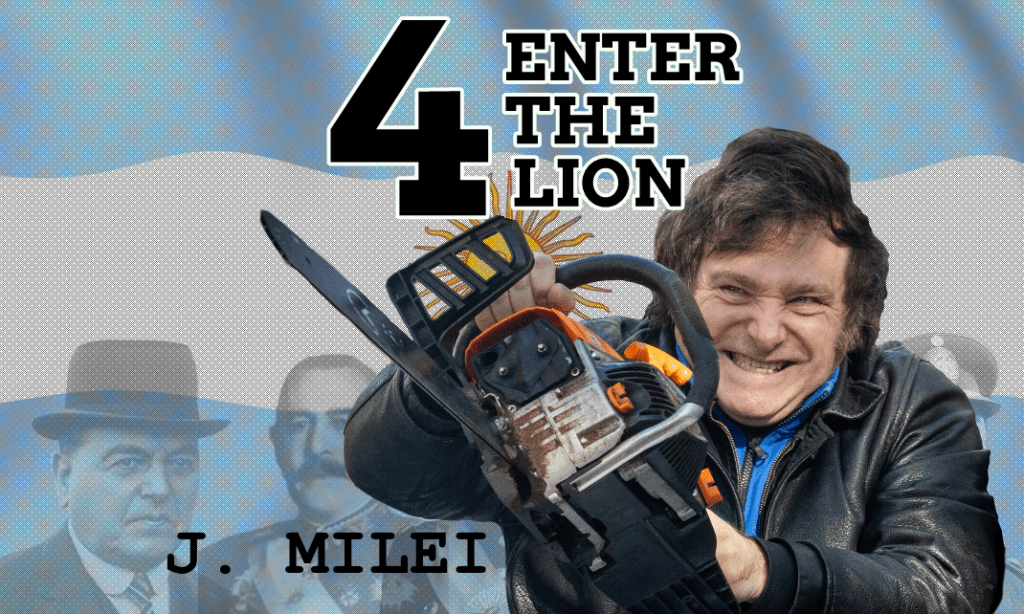
Who’s that on the horizon, wielding a chainsaw and wearing a dead cat on his head? That would be Javier “el leo” Milei. He was just elected President of Argentina last December. He was a soccer star in his youth, and sang in a Rolling Stones cover band (capturing Spud Underground’s attention). He saw the first round of insane inflation in the late 1980s and dedicated himself to the exciting world of economics. He’s a big fan of the aforementioned Mr. Hayek and others in the Austrian school. He’s the country’s first Libertarian President. He detests the socialists who’ve been screwing his country for the last century. He refuses to do business with communists, having pulled Argentina out of joining BRICS earlier this year. With that chainsaw, he’s slashed entire ministries out of existence and cut spending by unprecedented amounts. He announced at the World Economic Forum that Argentina is now an “unconditional ally” to entrepreneurs everywhere. Last but not least is his radical plan to dollarize the Argentine economy, to do away with the peso completely, and join the United States as a member of the free world.
Is this what it takes to bring Argentina back to being a global superpower of wealth and culture? Or will Milei’s work be undone by some other bureaucrat ten years down the line? Will the United States too be able to break our downward spiral into socialism, poverty, and cultural drought? Only time will tell; but in the meantime, Spud Underground proudly joins Javier Milei in his rallying cry: ¡Viva la Libertad Carajo! ■


 Spud media
One response to “The Insane History of Argentina”
[…] Then they screwed it all up. I already wrote about that. You can read it HERE. […]
LikeLike