

“Don’t get murdered,” suggested my coworker when I took time off for my trip. I’m sure in his Idahoan view of Chicago, I spent the trip dodging stray bullets on every sprint to the train and fighting off bad guys left and right. Chicago certainly has a reputation. From Al Capone to the modern, nameless street criminal, everyone knows that Chicago is a violent place.
That being said, who’s got a better story- the guy who got shot on his way to the most kickass music festival of all time, or the guy who stayed in safe ol’ Idaho and drank himself to death? So off I went, prepared for the worst. I brought along a decoy wallet in case of a mugging, and made peace with a few different gods in case I didn’t make it to my flight home.

For the most part, I spent my time there in crowded or well-patrolled places. The only exception was when I went to the Southside to catch a White Sox game. The Twins quickly trounced the Sox 4-0, and I was on the train back to my hotel with a big bag of Sox swag. I got off at the right station but took the wrong exit, and had no idea where in the hell I was.
This was it, boys. I was in unfamiliar territory in the most violent place in America. These streets were nearly vacant, and every passing figure became a potential attacker.
To avoid the mugger, you have to think like the mugger. If my income depended on other people emptying their pockets at gunpoint, I’d probably go for so many of the pedestrians I’d seen already: wearing $300 headphones and staring aimlessly into TikTok as they walked. So, I made a point to not look like a mark- eyes dead ahead, paranoid eye contact with everyone else, watching behind me in the reflection of windows. I only stopped to check the map on my phone, briefly, at intersections. My GPS couldn’t get a good read on me because of the buildings, so I mainly had to navigate my way back to Michigan Avenue by using skyscraper landmarks.
I made it back to my hotel with all of my money, swag, and internal organs intact. It’s all thanks to my tenacity and street smarts.
Unless, of course, Chicago isn’t that bad.
The standard narrative is that murder is way up, rent is way up, jobs and the economy are way down, and people are leaving in droves. It’s the death of another blue city, an I-told-you-so from right-wing media, likened unto the Great California Exodus and the fall of Portland, which those of us here in Idaho are all too familiar with.
Illinoispolicy.org reports that 2022 was the year of record population loss, making it 9 years in a row that the city has reported a decline. Outsiders might assume that violence is the reason, but most people cite high taxes as the push factor for emigration (I’d like the illiterate dopes at illinoispolicy.org to know that outmigration is not a word). That’s one source- but Macrotrends.net uses UN data to claim that Chicago’s population is actually trickling upwards for the last four years. So who do you trust?
As for crime, neighborhoodscout.com says the region I was lost in (Printers’ Row/Columbia College) is one of the gnarliest parts of downtown. They also claim that Chicago is in the 9th percentile of most dangerous cities in America. Interestingly, they also claim that my hometown of Salt Lake City is way worse, which is just plain silly. An article from the New York Post lists the 10 most dangerous cities to live in, and Chicago doesn’t even make the cut. It falls way behind cities like Bessemer and Birmingham, Alabama, as well as Detroit, MI and Cleveland, OH. Again, who’s right?
While Chicago’s own police department is quick to point out that the Windy City is breaking records for violent crime (over 55,000 reports filed year-to-date for 2023, 444 of which are murders at the time of writing), New York Post would also like to point out that crime is up everywhere in America. 236,000 crimes in the first 6 months means that Chicago’s 55,000 accounts for nearly 12% of America’s violence. That’s not great, but let’s not forget that Chicago is the third largest city in the country and that criminal activity is Pareto distributed (i.e., a tiny majority of individuals make up the vast majority of the data).
That was a lot of goddamn math, and we still aren’t closer to the truth. Sometimes, you just can’t trust what people are reporting, because everybody has an agenda. The only way to really understand something is to see and hear it with your own eyes and ears. Good thing I brought my eyes and ears with me so I can report it to you, and you can believe it or not.

There’s an old joke where you mention some heinous part of life in Soviet Russia, then conclude with “at least the trains ran on time.” In Chicago, the trains run on time, every time. Even on the Loop, where 4 lines share 2 sets of elevated tracks, and they all run every fifteen minutes. I’m astonished that I only saw a single delay during my trip. Every station had ample security, whether CTA personnel or actual cops. They weren’t whistling Dixie, either; I saw security get after a guy hard for being too retarded to operate a turnstile. I wonder what they do with actual problem children.
There are a lot of college kids in Chicago. Between University of Chicago, U of I Chicago, DePaul University, Columbia College and many others, there are loads of students roaming the streets. There were about a thousand of them getting coffee between classes at the Peet’s where I wrote most of this article. Generally, I don’t think kids would pick a city disintegrating into anarchy for their higher education.
There is a lot of construction going on. I saw at least 4 high-rises being built. Not renovated- built. Those are hundred-million dollar projects, and I don’t think banks would be interested in financing them if they thought Chicago was going down the tubes. Conversely, I only saw two or three abandoned buildings. The third tallest building in the city, St. Regis Chicago, was completed only 3 years ago. That’s a good sign for future development.

If crime is a product of a large city, culture is the equal and opposite reaction. Chicago has culture in spades: Chicago blues, Chicago school of architecture, Chicago dogs and deep-dish pizza, Cubs, White Sox, Bulls, Bears and Blackhawks. Architecture, murals, sculptures, fountains, live music venues, buskers, and film studios. Art, art, and more art. Everywhere you look, there is something to see. You don’t even have to look through homeless camps to see it.
And, of course, gigantic music festivals. I missed most of Riot Fest Day Three thanks to getting lost. I was really excited to see L.S. Dunes, a post-rock supergroup starring members of MCR, Circa Survive and Coheed and Cambria. I wanted to see Flogging Molly, too. I missed them both so I spent a while checking out the Douglass Park neighborhood for Part IV of this series. I caught the tail end of the Dresden Dolls’ set but saw The Mars Volta right after that.

I told a lot of people I was excited to see The Mars Volta. Most of their reactions included a question about Jared Leto. No, that’s 30 Seconds to Mars. I’m guessing the mass exodus of non-hipsters from the center of the crowd made that same mistake. Anyway, I enjoyed the set right down to the saxophone solo and the wacky percussion and Cedric’s fluffy hair. He shouted out his favorite local Chicago bands, which I thought was way cool. Those bands are Trenchmouth, The Vindictives, and 90 Day Men, if you care to check them out.

I didn’t want to watch The Cure for three hours, so that was the end. I hopped on the train, which ran exactly on schedule, and walked four Chicago-after-dark city blocks back to my hotel. I sadly sucked down an $8 PBR and ceremoniously removed my wristband. It was here that I wondered: is size the only difference between Chicago and Boise? Is Chicago’s culture so widely known simply because it’s seen by more people, or is there something about this city, perhaps big cities in general, that drives people to really push the boundaries and take more risks with their creations?
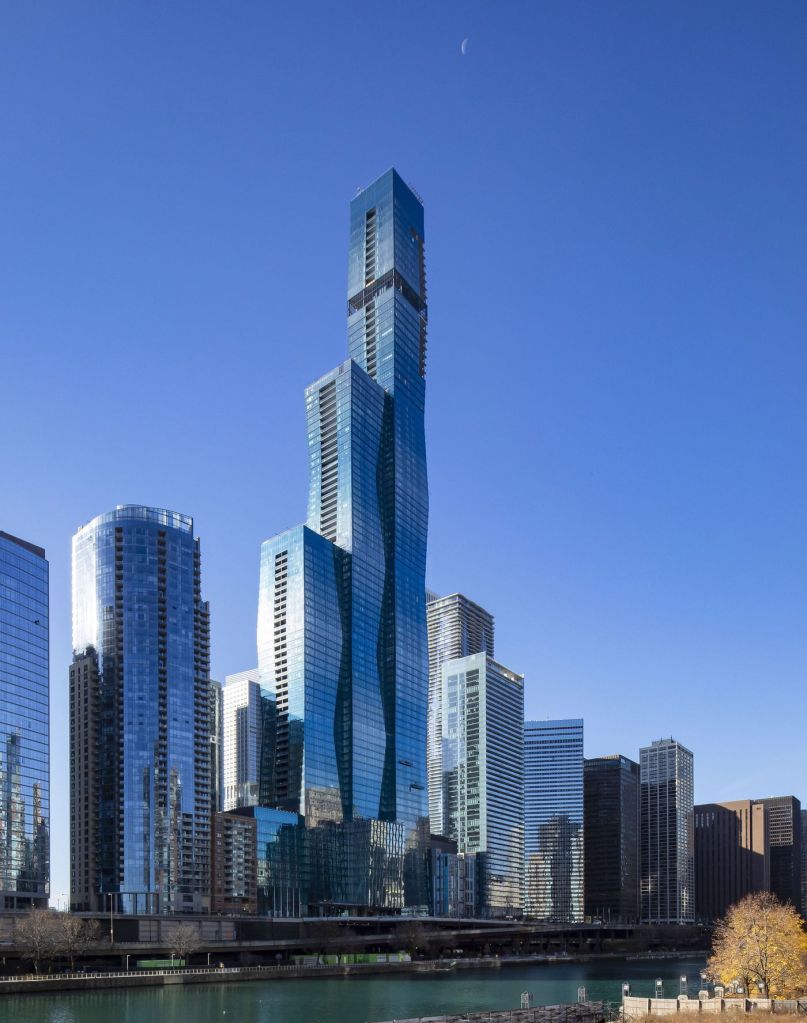
Chicago strikes me as a place where bold creators dare to do bold things. The aforementioned St. Regis Chicago stands as evidence of that. Nobody in their right mind would try build a record breaking tower during the economic uncertainty and political turmoil of the late 2010s, yet that’s exactly what happened. It’s a creative and unique building, an affront to the culture of safety and sterility of the times, and also happened to shatter the glass skyline by being the world’s tallest building designed by a woman.
I can’t help but compare apples and oranges here. Idaho has few to zero monumental achievements like St. Regis to boast, and it might be a cultural thing rather than a population thing. After all, people move here to escape the big rather than make it big. This results in a culture of not rocking the boat, not taking a huge risk, not building a deliberate affront to the status quo; and I’m sorry to say that this absolutely reflects on the music and art scene in Boise. Boise musicians are quick to disavow Idaho’s obsessive conservatism, but have only created the same ideological prison for themselves. Anything that doesn’t line up with what the scene believes is NOT allowed.
That’s not to say that they aren’t original or talented. Boise is teeming with talent and originality, but I believe that by prioritizing fitting in, you cap your own creativity. Instead of using art as a reflection of your inner self, you reflect a fictionalized inner self that you want others to see. It’s simply impossible to break the mold that way. Maybe Boise likes it like that, and it would be the same even if we had 3 million people here.
There’s definitely something special about Chicago. I could feel it in my bones.


 Spud media
One response to “Spud Takes Chicago Part III: Paris of the Prairie”
[…] magazine was not all the hate mail I received. It was the prize at the end of the potato-ey rainbow: a free pass to Riot Fest in Chicago. That was rock n’ roll. The whole trip reminded me of the unbelievable beauty that human beings […]
LikeLike