Any asshole with a pencil can write. It takes an artist to write well. Here are a bunch of tips I’ve compiled to help you improve your writing.
Understand the Rules, Then Break Them
A writer understands grammar, spelling, and structure the way a painter understands brushes, oils, and color palettes. These things are the tools you need in order to express yourself linguistically. sometimes youll need to brake those rules to illustrate a point or give you’re writing some extra character. Breaking rules on purpose is art. Breaking them accidentally is ignorance.
I met a writer once who’s work was so sloppy that it I couldn’t even read it. I told him so, and he said, “at least it gets the point across.” No, shithead, it doesn’t, because I can’t read it! Imagine if I showed Picasso a tree I painted and said, “It’s not terrible because it gets the point across!” Know the rules. Use them usually, break them sparingly.
Read, Re-read, and Re-read Again
NEVER publish a rough draft. The rough draft is necessary to the writing process, but is always full of logical errors, spelling and grammatical mistakes, and darlings that need to die. Odds are, when you “pants” your way through an article the first time, you’ve got several ideas competing for space on that page. Re-read it and figure out what you’re trying to say in the most distilled form, and cut out the rest. Make another article or split one up into chapters to make every point as directly as you can. When you’re done with that, re-read it again. And again. And again.
I like to do re-reads with a single intention in mind. The first one is usually fact checking. That means when I re-read it the first time, I’m ONLY looking at the information and making sure everything is accurate. My second re-read has to do with form, to make sure I’m only talking about one thing at a time and it all flows together. The third is about spelling and grammar. My fourth is to make sure it’s funny. If you focus on fixing one thing at a time, each layer of re-writes builds on top of the other and each color comes together like a stained glass window.
Kill Your Darlings
This bit of advice comes from Charles Murray’s book, The Curmudgeon’s Guide to Getting Ahead. This phrase has improved my writing more than any other pointer. The gist of the idea is this: writing is not talking. Talking allows a lot of freedom to explore ideas loosely, but writing is about communicating an established idea as economically as possible. The funniest joke in the wrong paragraph can distract from the point you’re trying to make, which kills the flow of the whole piece. Sometimes, your favorite phrases need to die in order to improve the article as a whole.
Get Drunk
Never force yourself to write. Nobody is interested in reading something that you weren’t interested in writing. If you have some ideas but you can’t get the words to come out, get drunk. This allows the ideas in your brain to escape without being caught by your logic processors, so you end up with a big steaming pile of the things you really want to say. Don’t worry that it’s messy and shitty, rough drafts should never be seen by other human eyes anyway. Let that drunk draft cool off overnight. Get some coffee and comb through it in the morning, with a good idea of what you’re really trying to say and hopefully some gold nuggets you can reuse in your second draft.
Change Your Routine
Having a steady routine is great for productivity, but lousy for creativity. If you’ve got writer’s block, change something up. Or everything. Wake up at 6 in the morning. Don’t drink coffee today. Go for a run first. Write by hand. Dictate into a microphone. Do something different and force yourself to get creative as a survival instinct.
Journal
Keep a diary like an 8-year-old girl. A journal is your own personal magazine where you write about the stuff going on that isn’t interesting to anybody else. More importantly, it’s your scratch pad. It’s the writer’s equivalent of noodling over a backing track. You can practice crafting metaphors and similes on the fly, structuring your paragraphs, and fitting jokes into your stream of consciousness.
It’s also terrific for your mental health. Journaling is like transferring data between RAM and a hard drive in a computer. As you go about your day, worrying about stuff and daydreaming and overthinking, you overload your RAM with more information that it can handle, which translates into anxiety. Channeling all of that stuff into a permanent record of ink and paper translates it into long-term storage and frees up short-term brainpower to think about something else.
Journaling should be fun. Don’t take it seriously. Use swear words and draw cocks. It’s not your memoir, it’s practice; and if you don’t enjoy your practice, you’ll never become great.
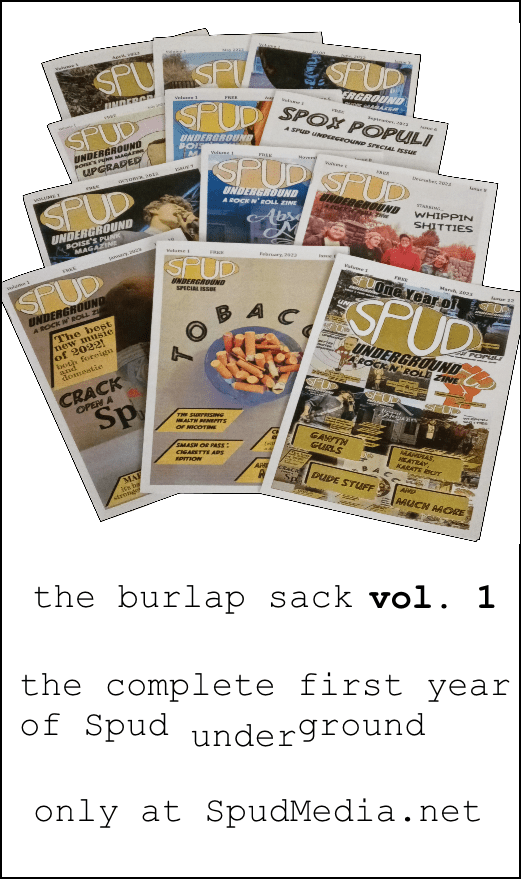
Spud Underground is Better in Print.
Order the Burlap Sack Volume 1 or Subscribe to read Spud as intended.