

I met Hayden through a mutual friend. After we got acquainted, it didn’t take long to get back to his place. He led the way into his basement, shut the door, dimmed the lights, and showed me all the gear that I’d heard so much about. Hayden is an audiophile, and his sound system is truly a marvel to behold.
“I had a fortunate entrance into this realm,” he told me. “My dad worked for a company that would install systems like this all over Utah. The 70’s and 80’s were big for old-school audio stuff. My dad got into it right at the end, the business doesn’t really exist anymore. People just don’t really sit down and listen to music in front of a big system like this anymore, it’s more personal.”
We poured some whiskey and passed around some smoke. We got locked into the couch and let this Decepticon that Hayden built do all the talking. We were there for hours, enjoying Porcupine Tree, Devin Townsend, Haken, Opeth; all the trippy prog metal we could eat.
I had to know how I could build a terrific system like this one. Hayden was more than happy to share all the details about how to build your own psychedelic battlestation. “Start with a receiver and a cheap pair of speakers and you’re off to the races. That’s a better system than most,” he said. “From there you get the bug to go bigger and better.”
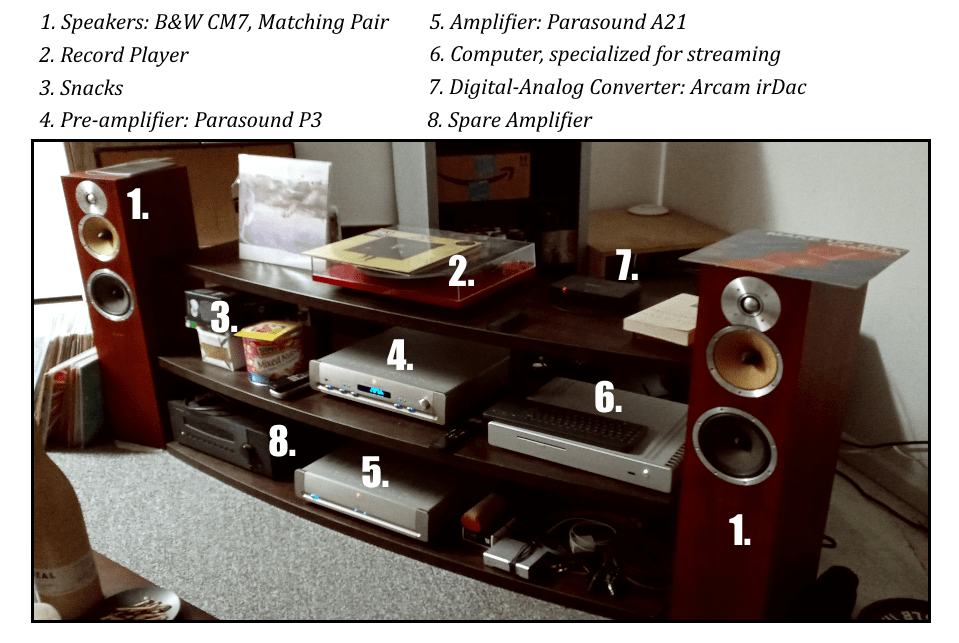
Speakers: B&W CM7, matching pair
Obviously, the meat of any sound system is the speakers. Hayden has a the Bowers & Wilkin CM7, a matching pair.
“B&W is a British brand, they produce all the way up to the six-figures range. They’re a full manufacturing company that makes every part of the speaker. Mine are a matching pair, made with MDF composite & rosenut veneer. The drivers (cones) are the expensive part. Braided and woven kevlar with resin, so they’re very lightweight. Expensive speakers tend to use exotic materials for strength and lightweightedness.”
Pre-amplifier: Parasound P3
Amplifier: Parasound A21
For a big system like this, you’ll need an amplifier and a pre-amp. Hayden has two seperate units, but you can get an integrated amplifier if you have limited space. An amplifier simply adds electricity to the sound signal to make it louder.
“The pre-amp is your source selection and volume dial,” Hayden explained. “A lot of amplifiers don’t have volume, it’s a fixed level of amplification. You need to change the level of the signal coming into it.
“My amplifier and pre-amplifier are made by the same company, actually from the same model line. They’re made by a company called Parasound, which is a middle-line manufacturer so you’re getting pretty good bang for your buck.”
If you have a record player, that will plug into the pre-amp. “Phono input requires a mini amp to bring it up to normal volume levels,” said Hayden. “Phono has low signal, and it needs to be boosted before it gets to the amplifier.”
Another thing to consider about amplifiers is that they give off a lot of heat.
“In the 70’s this analog stuff was really popular. Those amplifiers are still around and are based on old class A amplifier technology. Those amps are basically pulling all the power that they can from the wall. There’s nothing being changed from within the amplifier. All that old technology is really power inefficient, and anything that is not being used is being dissipated as heat. They’re totally designed to do that. The heat isn’t a problem, but it can be a problem depending where you put the amplifier.
“They look like Darth Vader or something with these heat sinks, but that’s part of the design. As long as they’re in open air space they’re totally fine, but as soon as you put them in cabinets or closed spaces, that’s where it becomes a problem. My Parasound is class A-B, which is this hybrid system that monitors what’s coming in from the input and pulls power from the wall on demand. My amps get warm, but they don’t get crazy hot. You can get away with putting them in a cabinet. Mine have about 6-8 inches of air above them, and they’ve never had a problem. The purists will say that Class A is still the way to go.”
Digital-Analog Converter: Arcam irDac
The last crucial element is called the Digital-Analog Converter. It turns digital signal from streaming to an analog signal that the system can understand.
“One thing I think people would be able to hear in two systems next to each other, is a good DAC vs a bad DAC,” Hayden said.
This is great! I’ve got all the right information to build my own system- but how many gas stations do I have to rob in order to make this happen?
“This is actually a pretty reasonable system,” Hayden answered. I bought the DAC, the amplifier and the speakers for about $1200 from one of the last remaining audio shops in Utah. I went over to his house and had a little listening session with him, that’s how I got into these products and built the system I have. The original amplifier I sold, it was an integrated amplifier, and I didn’t like that. I like to tinker, and I couldn’t do it with this system.
“My record player was about $700. Last year I did upgrade the cartridge for the unit to a nicer piece of equipment. The wood it’s made of can make a big impact on the sound. This cartridge was about $400 or so. So, my system is getting into the modest range of $2000-$2500. Most of this stuff is 20 years old, and mostly aftermarket. It’s old equipment but it’s still around and still kicking, sounds great. None of it has been abused as far as I can tell.”



 Spud media
Leave a comment